

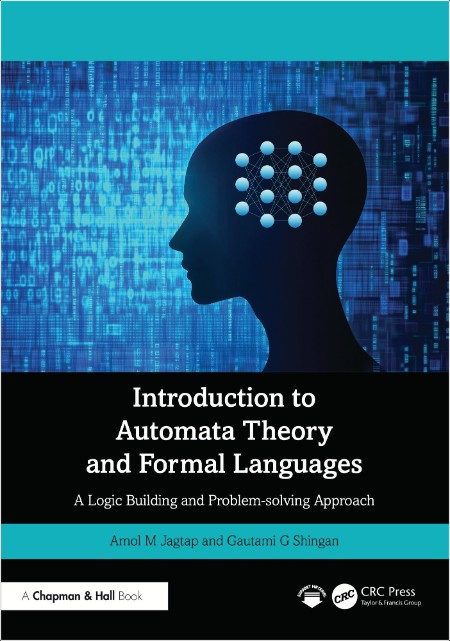
Introduction to Automata Theory and Formal Languages A Logic Building and Problesolving Approach | 190.47 MB
Title: Introduction to Automata Theory and Formal Languages: A Logic Building and Problem-solving Approach
Author: Amol M Jagtap and Gautami G Shingan
Category: Nonfiction, Computers, Advanced Computing, Programming, Compilers, General Computing
Language: English | 349 Pages | ISBN: 0471439606
Description:
This book provides a structured introduction to automata theory, bridging theoretical foundations with practical applications. Designed for students, researchers, and professionals, this book explores fundamental concepts like deterministic and non-deterministic finite automata, context-free grammars, pushdown automata, and Turing machines. It emphasises problem-solving, critical thinking, and real-world applications in areas such as compiler design, natural language processing, and network protocols.• Offers step-by-step learning, progresses from DFA and NFA to CFG, PDA, and Turing machines, ensuring clarity and depth.• Offers step-by-step explanations for automata design, language properties, and computational problem-solving.• Covers automata applications in lexical analysis, pattern matching, network protocols, and AI.• Challenges readers to apply concepts beyond memorization, fostering analytical skills, uses graphical representations to enhance understanding of automata transitions and operations.• Demonstrates how automata theory influences cybersecurity, software development, and computational linguistics. This book is an essential resource for students and professionals in computer science, providing the logical foundation and problem-solving skills needed for careers in theoretical computing, artificial intelligence, and software engineering.
This book provides a structured introduction to automata theory, bridging theoretical foundations with practical applications. Designed for students, researchers, and professionals, this book explores fundamental concepts like deterministic and non-deterministic finite automata, context-free grammars, pushdown automata, and Turing machines. It emphasises problem-solving, critical thinking, and real-world applications in areas such as compiler design, natural language processing, and network protocols.• Offers step-by-step learning, progresses from DFA and NFA to CFG, PDA, and Turing machines, ensuring clarity and depth.• Offers step-by-step explanations for automata design, language properties, and computational problem-solving.• Covers automata applications in lexical analysis, pattern matching, network protocols, and AI.• Challenges readers to apply concepts beyond memorization, fostering analytical skills, uses graphical representations to enhance understanding of automata transitions and operations.• Demonstrates how automata theory influences cybersecurity, software development, and computational linguistics. This book is an essential resource for students and professionals in computer science, providing the logical foundation and problem-solving skills needed for careers in theoretical computing, artificial intelligence, and software engineering.
DOWNLOAD:
rapidgator.net/file/64c4366463aec62b70ee6a7463d8dabc/Introduction_to_Automata_Theory_-_Amol_M_Jagtap.rar
nitroflare.com/view/08445AC3A7C7BDE/Introduction_to_Automata_Theory_-_Amol_M_Jagtap.rar

Please click on Below donate button to keep site alive
