

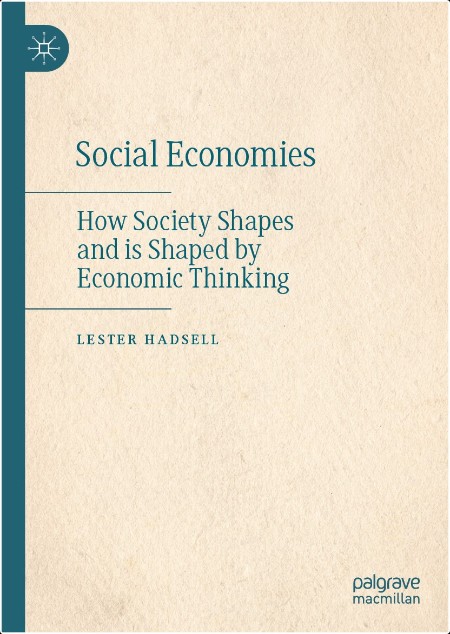
Social Economies How Society Shapes and is Shaped by Economic Thinking | 9.94 MB
Title: Social Economies How Society Shapes and is Shaped by Economic Thinking
Author: Lester Hadsell
Language: English | 332 Pages | ISBN: 3032219159
Description:
What are the limits of markets? What moral responsibilities do businesses have? To what extent is individual economic success shaped by personal effort versus social factors?
In Social Economies, Lester Hadsell examines these questions across twenty clear chapters, analyzing the connections between economies and society. Drawing on research from economics, sociology, psychology, philosophy, and biological sciences, the book frames economies as networks of social and biological relationships rather than as isolated technical systems.
Part I explores how values influence views of economic systems, contrasting mainstream economics with Marxist, feminist, ecological, and Buddhist perspectives. It concludes that no single “economic way of thinking” exists and considers how far market principles should extend.
Part II addresses the goals societies pursue through their economic systems. Topics include alternatives to growth, economic freedom, and the responsibilities of businesses to customers, workers, suppliers, and communities. Two chapters examine economic inequality, tracing its persistence across generations to social and biological factors.
What are the limits of markets? What moral responsibilities do businesses have? To what extent is individual economic success shaped by personal effort versus social factors?
In Social Economies, Lester Hadsell examines these questions across twenty clear chapters, analyzing the connections between economies and society. Drawing on research from economics, sociology, psychology, philosophy, and biological sciences, the book frames economies as networks of social and biological relationships rather than as isolated technical systems.
Part I explores how values influence views of economic systems, contrasting mainstream economics with Marxist, feminist, ecological, and Buddhist perspectives. It concludes that no single “economic way of thinking” exists and considers how far market principles should extend.
Part II addresses the goals societies pursue through their economic systems. Topics include alternatives to growth, economic freedom, and the responsibilities of businesses to customers, workers, suppliers, and communities. Two chapters examine economic inequality, tracing its persistence across generations to social and biological factors.
DOWNLOAD:
rapidgator.net/file/0762de3a3664ad068219285822f19861/978-3-032-21916-9.rar
nitroflare.com/view/97DA5BE62998140/978-3-032-21916-9.rar
