

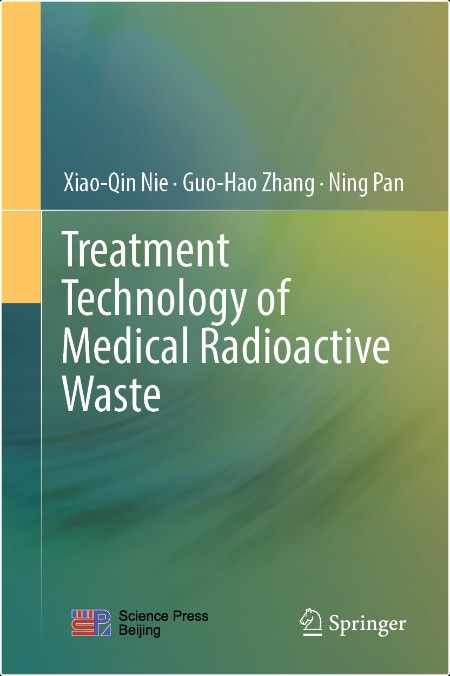
Treatment Technology of Medical Radioactive Waste | 113.59 MB
Title: Treatment Technology of Medical Radioactive Waste
Author: Xiao-Qin Nie, Guo-Hao Zhang, Ning Pan
Category: Nonfiction, Science & Nature, Technology, Engineering, Environmental, Health & Well Being, Medical, Specialties, Radiology & Nuclear Medicine, Civil
Language: English | 420 Pages | ISBN: 9381039879
Description:
This book addresses the critical challenge of managing radioactive waste generated in nuclear medicine-a field experiencing rapid growth due to its transformative role in precision diagnostics and cancer therapy. As the global nuclear medicine sector expands, traditional waste treatment methods struggle to keep pace with the surge in short-lived isotopes like iodine-131 and lutetium-177, which require advanced separation and purification techniques. The authors present a groundbreaking, multidisciplinary approach integrating molecular chemistry, material science, and engineering innovation. Key advancements include: Novel separation materials: Functionalized ion-exchange fibers and biomimetic mineralization materials designed to target specific radionuclides with high efficiency. AI-driven monitoring systems: Real-time radiation detection and predictive analytics for safer waste handling. Modular treatment systems: Mobile and fixed installations optimized for hospital workflows, reducing storage risks and compliance costs. Richly illustrated with case studies from China’s first hospital-based waste treatment facility, the book bridges theoretical research (e.g., molecular dynamics simulations) and practical engineering solutions. It also evaluates global regulatory frameworks, offering actionable insights for policymakers. Essential for nuclear medicine practitioners, environmental engineers, and regulatory professionals, this volume provides the tools to transform radioactive waste from a liability into a manageable resource, aligning with global sustainability goals.
This book addresses the critical challenge of managing radioactive waste generated in nuclear medicine-a field experiencing rapid growth due to its transformative role in precision diagnostics and cancer therapy. As the global nuclear medicine sector expands, traditional waste treatment methods struggle to keep pace with the surge in short-lived isotopes like iodine-131 and lutetium-177, which require advanced separation and purification techniques. The authors present a groundbreaking, multidisciplinary approach integrating molecular chemistry, material science, and engineering innovation. Key advancements include: Novel separation materials: Functionalized ion-exchange fibers and biomimetic mineralization materials designed to target specific radionuclides with high efficiency. AI-driven monitoring systems: Real-time radiation detection and predictive analytics for safer waste handling. Modular treatment systems: Mobile and fixed installations optimized for hospital workflows, reducing storage risks and compliance costs. Richly illustrated with case studies from China’s first hospital-based waste treatment facility, the book bridges theoretical research (e.g., molecular dynamics simulations) and practical engineering solutions. It also evaluates global regulatory frameworks, offering actionable insights for policymakers. Essential for nuclear medicine practitioners, environmental engineers, and regulatory professionals, this volume provides the tools to transform radioactive waste from a liability into a manageable resource, aligning with global sustainability goals.
DOWNLOAD:
rapidgator.net/file/5b6e6589cc76a784c0d041ec83d4a3df/978-981-92-0944-6.rar
nitroflare.com/view/EE9E740F853AB28/978-981-92-0944-6.rar
